Ingenium — AI-Native Legal Intelligence for Canadian Law Firms.
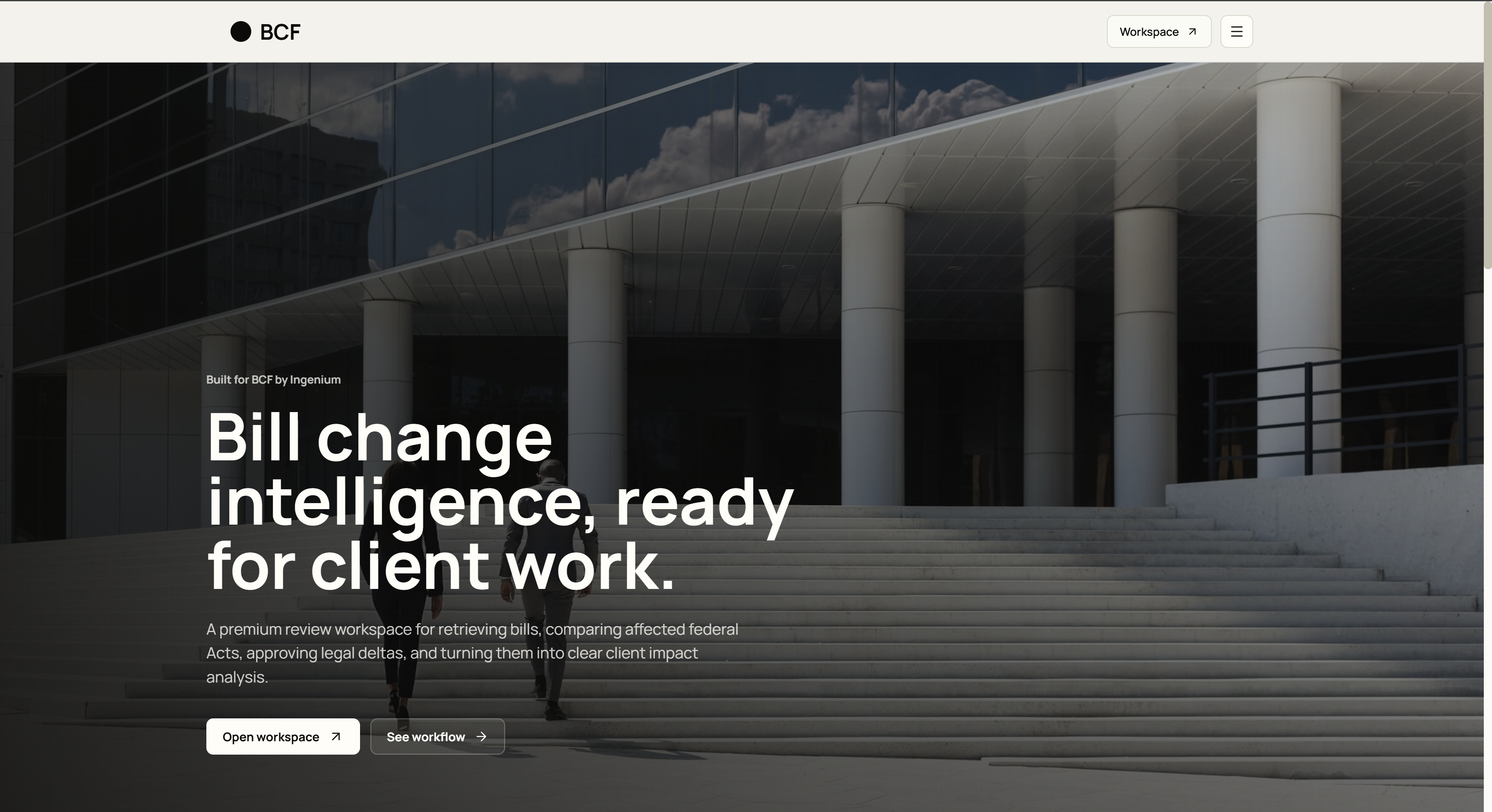
An internal tool for Canadian law firms that turns federal bills into client-specific legal advice in minutes instead of weeks.
Experience
Built at the AI x Law Hackathon, and the first hackathon I ever walked into completely blind, no plan and no friends on the team. I ended up meeting strangers in the room, forming a team, and building Ingenium with them over the weekend. Presenting in front of the full crowd of builders and sponsors at the end was a very unique experience, especially knowing there were law firm partners and CEOs sitting in that audience. Hence why I really cared about every slide and every line of the demo making sense to someone who has never written a line of code.
Motivation
I went in mostly curious about how AI actually shows up in law, and pretty quickly realized it barely does. Talking to the law students on my team, I kept hearing the same thing: tracking a federal bill, figuring out which existing statutes it amends, and then telling each affected client what it means for them is essentially manual, and most of it never gets done in time. That gap felt like exactly the kind of problem worth pointing an LLM at, and the law students could tell me what “useful” actually looked like for a practising lawyer. Hence Ingenium, a tool that takes a bill from LEGISinfo, reconstructs the future version of the statute it amends, and drafts client-specific advice for the lawyer to review.
Learned
I learned a lot about how procedures within law actually work, and how cautious that world is about AI, which makes sense once you sit with a law student for an hour and hear how high the stakes of a wrong answer are. On the technical side, I got more comfortable with grounded LLM design, using Gemini 2.5 Flash in strict JSON mode with TypeScript types shared end to end so every AI output validates against a schema before the UI ever sees it. I built a small data pipeline that pulls official XML from LEGISinfo and the Justice Laws site and normalizes it into something diff-able, which is what powers the CanLII-style side-by-side view of current law against the post-amendment law. On top of that, I learned how to take in requirements from non-technical teammates and translate them into something buildable in a weekend, while being honest about what was possible and what was not. Beyond these, the soft side was probably the biggest takeaway, going in alone, ending up with teammates I genuinely appreciate, and presenting to a room of people whose day jobs are the exact thing the product is trying to help with.